

The best garage floor coating kits, also known as epoxy paint kits, are not what you may think. If you were expecting a comparison of Rust-Oleum EpoxyShield, Quikrete, Valspar, RockSolid, or some other kit you’ve seen at your local home improvement store, you may be in for a surprise.
The best garage floor coating kits are the newer single-part polyurea coatings. They are the easiest to apply, longer lasting, and offer the best protection.
Not familiar with polyurea garage floor coatings? No worries, the majority of other people aren’t either. Consumers who want to apply a DIY coating to their garage floor are commonly familiar with the term “garage floor coating kit”, “epoxy paint kit”, etc. When using these terms, they are typically referring to epoxy coatings and the above-mentioned products.
Why? The reason is simple. These types of kits have been marketed and promoted for many years by the large companies that manufacture them. Rust-Oleum is a good example. These are the typical residential-quality DIY garage floor coatings. They are designed to be applied in one coat with the optional decorative color flakes to toss on top.
In addition, they are packaged in an eye-catching box that includes the coating, a small bag of color flakes, and an ECO-friendly etch/cleaner solution. It’s not everything you need to get the job done, but they like to use the word “kit” to sound all-inclusive for marketing purposes.
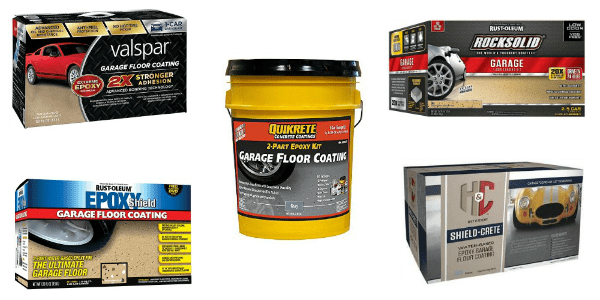
These are most prevalent in the home improvement centers and hardware stores where they are seen on a regular basis. As a result, this is all the average consumer is aware of for coating choices in many cases.
The problem with most of these garage floor epoxy products, however, is that they are on the low end of the scale in terms of quality, durability, and performance. This is particularly true when compared to the vast majority of garage floor coatings available.
We suggest reading this article here to understand more about what to expect with these types of coatings. In addition, we have a new article that explains the reasons behind the bad reviews of garage floor coatings.
Now that you know the history of these epoxy paint kits, let’s discuss what makes the newer single-part polyurea garage floor kits so much better.
What is a polyurea coating anyway?
Put simply, polyurea is a subset of polyurethane. It is a coating that seals and exhibits excellent chemical, stain, and abrasion resistance. The high elongation rate of polyurea makes for a flexible (relatively speaking) surface.
Coatings that flex provide very high abrasion and scratch resistance. This is one of the reasons why polyurethane and polyurea are much better topcoats than epoxy for most environments.
Polyurea is actually fairly new for a coating. It was commercially developed in the 1990s and was most known in the industry as a spray-on coating for bed liners, pipe linings, water tanks, pool coatings, etc. When mixed with a catalyst in a sprayer it can cure in as little as 5 seconds. It can also be applied in extremely cold and warm temperature conditions.
It was later developed as a 2-part polyurea polyaspartic roll-on concrete floor coating. This version has become very popular with many garage floor installation companies. The cure rates of less than two hours can provide a 1-day return to service for a complete garage floor coating system.
This is sold as an advantage over a standard epoxy garage floor system. Most epoxy systems require a minimum of three days to cure before a full return to service.
The high solids 2-part formulas used for these garage floor coatings are expensive, however. It requires experienced installers to apply properly due to the short working time (pot life) of only 20-25 minutes. This is why it has not been popular for DIY applications – that is until recently.
Why single-part polyurea coatings are better than epoxy paint kits
One particular formulation that has been introduced to the floor coating industry in recent years is single-part polyurea. Most polyurea formulas require mixing a part-A resin and a part-B catalyst – just as epoxy does.
Single-part polyurea does not require the mixing of two components. Instead, the oxygen in the air provides the catalyst that the coating requires to chemically cure.
Single-part polyurea is a commercial quality garage floor coating that is the easiest of all coating to apply – period.
With the addition of solvents in these formulations, manufacturers have created an extremely durable polyurea garage floor coating. It does not require mixing A and B components, has unlimited pot life, and can easily be applied to concrete.

Many mistakes from DIY epoxy coating applications are generated from improper mixing of the A and B components. The anxiety of this mixing process is a common deterrence that causes some people to shy away from installing epoxy in their garages.
Shop our collection of Single -Part Polyurea Kits from Top Vendors
RockSolid has tried to eliminate mixing mistakes with the introduction of burst pouches to mix A and B components, but problems still exist. The single-part polyurea coating eliminates this step and greatly reduces the chances of DIY installation errors.
To be more concise; Single-part polyurea is a commercial-quality garage floor coating that is the easiest of all coatings to apply – period.
Furthermore, the typical epoxy coating and garage floor coating kits, as mentioned above, are no match for the superior durability, chemical resistance, scratch resistance, and abrasion resistance of single-part polyurea coatings.
For example, commercial quality coatings provide a list of ratings based on testing. You can find these ratings as well as other pertinent figures in the Technical Data Sheets. This is what allows consumers to compare and evaluate how coatings will perform.
Abrasion resistance and chemical resistance are two standard tests that can provide very good information.
The example below is a chemical resistance chart that lists how a particular product will react to a variety of liquid chemicals including acids and solvents.
You can’t find this kind of information for your typical epoxy paint kits by Rust-Oleum, Valspar, H&C ShieldCrete, RockSolid, etc. It’s not listed. Instead, they use very vague terminology such as “anti-peel protection”, “2x stronger than concrete”, “hot tire resistant formulation”, and “long-lasting results”. They do not provide any testing data to back up these claims.
To their credit, RockSolid provides an abrasion resistance rating, but they do not provide chemical resistance data. The rating they provide for abrasion resistance is 40mg. This is how much material is lost during 1000 cycles for a CS-17 abrasion wheel test. The lower the abrasion numbers the better. As a comparison, many single-part polyureas test at only a 12mg loss.
Important to note is that each mg unit of loss is exponential. For example, a coating with a 4mg loss compared to a coating with an 8mg loss would last 3 times as long in terms of wear under the same conditions – not 2 times as long as most would assume.
Now, can you imagine how much better a 12mg loss coating performs than a 40mg loss coating when it comes to wear and abuse?
Additionally, polyurea is U.V. stable whereas epoxy is not. This means that your coating will not amber (yellow tint) over a period of time when exposed to sunlight. This is a typical complaint about epoxy paint kits.
Coating thickness is another issue. Most DIY epoxy garage floor kits have a dry film thickness of only 2-3 mils when applied at the standard coverage rates. Thin coatings such as these can sometimes create cosmetic issues with the color looking inconsistent and blotchy. This is due to the coating being absorbed at different rates into the concrete.
Single-part polyureas on the other hand have a 4-6 mil dry film thickness. The thicker coating makes for a more durable surface and does not suffer color inconsistencies.
Benefits of single-part polyurea coatings
- No mixing of A and B components
- Long working times so you don’t feel rushed
- Recoat times as little as 2 hours versus 10-12 hours
- No primer required
- Can be applied in lower temperatures – most epoxy paint kits require a minimum of 60°F
- Over 50% thicker coating than standard epoxy paint kits
- Long lasting – 10 years or more versus 2-5 years for standard epoxy kits
- No hot tire lift – water-based epoxy kits will get hot tire lift
- 100% U.V. stable for no yellowing – epoxy kits will turn yellow over time
- 100% more flexible than epoxy for superior scratch resistance
- Higher gloss ratings than most epoxy kits – maintains gloss longer
- High chemical and abrasion resistance – data not available for epoxy kits
- Excellent protection against road salts and deicing fluids
- Can be used as a clear sealer over bare concrete or stained concrete
- Available in both gallon and quart sizes to modify for any square footage
Single-part polyurea coatings can be used as a one-coat stand-alone system if you like. You can add color flakes or not just like the standard epoxy paint kits. You also have the option of applying a clear topcoat of polyurea for a two-coat system. This can provide for a full color flake floor of your choosing to get a real custom look.
Another advantage is that single-part polyurea is available in gallon and quart sizes. This allows you to order only what you need for your square footage to avoid overspending.
Most garage floor coating kits only allow for purchases of 250ft² at a time. If you have a 550ft² garage floor, you would need to purchase three kits. There is no way you could stretch out two kits for the 550ft² without cosmetic and performance issues.
Concrete preparation is the same for single-part polyurea as it is with any other epoxy coating kit. You need to etch or grind the concrete to create the correct surface profile. This will open up the pores of the concrete at the surface for the coating to penetrate and achieve a mechanical bond.
One characteristic of single-part polyurea to be aware of is that it is solvent-based. There will be some strong fumes during the application. However, most of the smell from the fumes dissipates within a few hours as the solvent evaporates out of the coating.
As with any solvent-borne coating, it’s not uncommon if it takes a few days for the smell to completely diminish. However, it will go away.
Polyurea coatings can also be more slippery when wet compared to epoxy. The curing process produces a tightly cross-linked structure that smooths out almost like glass. This is one of the reasons it cleans up so easily and is very difficult to stain.
If you live in a wet climate or worry about the floor being slippery, we would suggest adding an anti-slip additive to the final coat.
Additionally, they are not the best choice if you have a concrete surface with numerous cracks and/or surface irregularities. Though thicker than their epoxy paint counterparts, they still are not thick enough to fill in such surfaces. A high solids or 100% solids epoxy is a superior candidate since they are better at self-leveling with a dry film thickness of 9-10 mils and higher.
Lastly, single-part polyureas are packaged in clear only. They require you to mix in a pigment pack for the color you choose. However, this is not the same as mixing 2 components. Just pour in the pigment pack and mix it with a paint stick. This does not activate the coating, nor does it require you to immediately apply it after you mix in the color packs.
This post may contain affiliate links. If you use these links to make a purchase, we may earn a small commission. You can read our full disclaimer here.
Where to purchase polyurea garage floor coating kits
One of the best advantages of purchasing a single-part polyurea is that they are only available from vendors that specialize in concrete coatings. These are the same companies where professional installers buy their coating materials.
Legacy Industrial was one of the first vendors to offer a single-part polyurea in a DIY application. Called Nohr-S, we were so impressed with the coating that we wrote an article about it.
Some time afterward, ArmorPoxy made their SPGX polyurea available to the public. One of our readers in Chicago applied it to his garage floor and we did an article about the process here.
The latest to offer a polyurea coating in kit form is Garage Flooring LLC. Customer service is excellent and they are more than happy to help you and answer your questions. You can read our latest evaluation of their All Weather Floor polyurea.
Unlike home improvement centers, these vendors are experienced in garage floor coating applications and are extremely knowledgeable. They want you to be successful with your project. Customer service is excellent in most cases and they can answer any questions that you have about the product and application.
They are also very good at making sure you understand what you are purchasing. They will tell you if the product you are interested in is the best choice for you or not. We highly recommend contacting these vendors with any questions you may have before making a purchase.
Important to note is that these vendors are not national brand companies with brick-and-mortar stores that you can walk into. Products and materials are ordered online via their websites and then shipped directly to you. With some exceptions, most of these companies ship for free as well.
Though the coatings don’t come in a neatly packaged box with nice artwork and graphics, they can provide everything you need in true kit form for a successful application.
you would have to purchase and go through the process of reapplying an average of four water-based epoxy paint kits over the life of just one single-part polyurea coating.
The cost per square foot for a single-part polyurea coating averages about twice that of the lowest-priced, water-based epoxy garage floor kits. RockSolid polycuramine and the solvent-based Rust-Oleum EpoxyShield Professional coatings are priced midway between.
1 gallon covers approximately 250ft², the same as most epoxy paint kits. SPGX by ArmorPoxy covers 300-400ft² per gallon, but the additional square footage is reflected in their price point.
Though the initial cost of single-part polyurea garage floor coating is higher than the typical epoxy paint kits, they are a much better value. This is particularly true when you carry that expense out over the many years of use.
For example, you would have to purchase and go through the process of reapplying an average of four water-based epoxy paint kits over the life of just one single-part polyurea coating.
Are polyurea garage flooring kits the best of all garage floor coatings?
One important question that people want to know is how single-part polyurea coatings compare to other garage floor coating systems available. Is it better than epoxy? Is it better than polyurethane? Is this the best garage floor coating I can apply?
A single-part polyurea garage floor coating kit or system is the best choice for those who want a professional-looking, commercial-quality coating. It is the easiest to install and at a reasonable price point.
They deliver excellent performance and long life. They are best for the typical residential garage that will see light to medium-duty automotive repair and medium to heavy traffic. This includes inclement weather conditions and other hobby or home improvement projects that are performed in the garage.
Application is easier than epoxy paint kits. They will not experience the potential peeling, hot tire lift, color fade, and wear over 2-5 years that is typical of such kits.
However, in terms of ultimate performance and durability, nothing outshines a hybrid coating system. Such a system consists of an epoxy primer, a high-solids epoxy color coat, and one or two coats of a high-performance polyurea or polyaspartic topcoat. We discuss the best garage floor coating systems here.
Final thoughts
Needless to say, we are impressed with this product. Hands down, single-part polyurea is the easiest of all coatings to apply while still performing to commercial quality standards. It delivers excellent protection and performance at a reasonable price point compared to other products.
The large companies that provide inexpensive epoxy paint garage floor kits have been relying on relatively older epoxy coating formulas for years. We would not be surprised if one of them doesn’t come out with their own version of this polyurea shortly. It would eliminate many of the complaints about their products.
Until then, the biggest problem that single-part polyurea will face is a lack of exposure to the general public. The smaller companies that sell the higher-performing garage floor coatings do not have the budget for the type of national advertising that is required.
Though it’s not the cheapest garage floor coating, for the value it’s one of the best DIY garage floor coatings available that you can purchase in kit form.
I have prepped my basement floor and want to have a high gloss marble finish in black and grey, what system do you recommend? I have read your comments about the rocksolid marble floor coating and also your comments about using high performance 100% solids. Now i am not sure which to use. I do want to add a top coat that is gloss to ensure more durability for high traffic in the basement. But I want a marble affect. also not sure if i need to put on a primer first or not with either paint. what paint or kit do you recommend that will last so i do not need to redo this process. and, if i use a top coat, how long do i wait after floor is painted to apply the top coat? will the top coat make the floor too slippery? thanks for all your advice!
Hi Donna. RockSolid Marble is a fairly simple DIY kit that somewhat mimics true marble-like coatings. It’s designed as a one-coat application and lacks the thickness, deep look, and same marbling of the marble coatings you typically see displayed by commercial installers. In addition, it’s a proprietary polycuramine that is not intended to be mixed with other coatings. These types of kits are put out in masses to the general DIY public at an inexpensive price (relatively speaking) and do not perform or look the same as the commercial quality coatings. They don’t look bad, they just don’t provide the same look and durability. You cannot apply it thicker than the recommended coverage rate or you will experience bubbles. Our recommendation is to apply a single coat and see what you get. Most likely the color will be good, but if not, you will need to apply another coat. In order to protect the color coat and to provide a non-slip surface, you would need to apply a RockSolid clear coat with the supplied anti-slip media mixed in. Keep in mind that this will tack some of the gloss out of the surface.
Commercial quality marbled coatings require that the surface be acid etched or ground with a 25 grit diamond segmented disc. A dark epoxy primer (not paint) or colored primer is applied to help accentuate the main marble color. It also helps to provide more depth in the look. A 100% solids epoxy is then applied via squeegee (thickly and low coverage rate 80 – 100 sq. ft. per gallon) and the highlights immediately thereafter. It is then backrolled to smooth the surface out and mix in the highlights. A clear polyurethane or polyurea is then applied with anti-slip added. This type of coating is on average 3-4 times as thick. The clear coat needs to be 100% solids or a water-based polyurethane in order to avoid VOCs for a basement. This video here shows the typical process, not including the clear coat.
Great article; thank you!
I have a small (9 x 6) laundry room in a converted garage. The floor was painted w/ concrete paint about 10 years ago. I am replacing washer & dryer, so thought it would be a good time to upgrade. Is there a recommended DIY option? There are some cracks and pits that would need attention in prep phase. What would you recommend?
Hi Debbie. We have an article here about repairing cracks and pits. Is there paint still on the concrete?
Great article – thank you!
I am building a new garage and am looking at doing a coating myself on the new floor.
Living in Canada, we need to take into account wear and tear on the floor, especially in winter months with ice/snow and salt from the roads. Can you comment on how these products stand up in these conditions?
Hello Kevin. As long as you are using studded snow tires it will hold up just fine to those conditions. Some of the vendors we recommend shipped to Canada at one time, but I’m not as sure anymore. You will need to check. Unfortunately, we don’t have any leads on who carries it in Canada.
I recently had a professional install epoxy flooring with flakes in my basement. It looks good, but the finish is too rough for living space (I had expected it to be smooth for easy cleaning). Should I ask the contractor to put a top coat of a polyurea? Would this fix the problem? Thanks.
Hi Leslie. No, most polyureas have solvents in them. These solvents / VOCs evaporate out and create an odor. It’s fine for a garage that is open to the outdoors since the solvent odors quickly dissipate. However, it can linger for weeks or more in a basement. A 100% solids epoxy clear coat is the solution. 100% solids epoxy does not have solvents and is VOC free. In addition, it can be applied much thicker in a single coat to smooth out the floor. And because it’s in a basement, there is no worry about direct sunlight causing the epoxy to amber (yellow tint) as it can in a garage.
I have read many of your articles and they are great help. THANK YOU. I am starting a big project in our new house. We have 1600 sq ft of concrete floors. I am painting all the floors with black floor paint, adding swirls of water based metallic paints in 3 colors then texturing it with mop. I need a good durable sealer/topcoat. I read your article on all the topcoats and their differences. I am leaning towards the single part Polyurea. Will this adhere to my painted floor and give me a strong durable finish? Also can I add sharkgrip to the final coat? I have rescue dogs so my floors take abuse. Any help or advise you can give, is much appreciated.
High Stephanie. Are these standard acrylic concrete paints that you are using? Have they been applied yet? Is anyone living in the house currently?
Base layer will be a standard black concrete paint. The metallic accent paints will be rustoleum metallic accent paint which is a water based paint. House is under construction and I have not applied or even purchased any paint as of yet. My original plan was to acid stain all the concrete but the concrete is not taking the acid stains at all. We have applied it in 2 inconspicuous places. Thank goodness I tested the stain first. I saw the technique using paint and decided it would be better option for the look I want. I’m open to any suggestion though so if you know of a better product or technique, please let me know.
Hi Stephanie. Coatings typically are not compatible with paint. There are many differences. Most importantly, they do not chemically bond to each other as coatings do. In addition, paints do not bond to concrete as well as coatings do. A coating can be applied to paint, but it requires that the painted surface be roughed up with 120 grit sandpaper first in order to achieve the proper mechanical bond. The problem with this is that most high-performance clear coats that can withstand the abuse from dogs are solvent-based. When applied to paint, particularly water-based paint, there is a high chance of the solvents softening the paint and causing it to bleed into the coating or even breaking the bond of the paint to the concrete. 100% solids clear epoxy can be applied since there are no solvents to speak of. It is a very durable coating. However, epoxy is prone to very shallow scratching since it is so hard. The dog’s nails will eventually do this over time. This is why polyurethane or polyurea clear coats are more desirable. They have flex (relatively speaking) and are much less prone to this. Coatings with solvents (single-part polyurea) produce VOCs which can really stink up the inside of a house and is why they are not used indoors. However, if the house is not fully constructed yet and there is adequate ventilation, it can be used. They work fine in garages because the garage door can be open to ventilate the first few hours or so.
If you like the idea of metallics, then we would suggest a metallic epoxy flooring system. We discuss them here. Once applied, you can apply a single-part clear polyurea during the recoat window. This provides for a chemical bond with no sanding. RockSolid offers metallic coating kits, but they don’t quite provide the same look and are much thinner, though they are easier to apply. If you apply RockSolid, we would recommend letting it cure for 24 hours or so, lightly sand the surface, and then apply a single-part polyurea clear coating or similar. The RockSolid clear coat is similar to an epoxy clear coat. Something to keep in mind is that most coatings like this will require that you etch or grind the concrete first. In addition, darker colors always show scratches, dirt, and other cosmetic issues much more than lighter colors.
Hi great article, good to read the advice. We recently put down the Epoxy Shield 2 part coating with flakes for our garage. We want to put a top coat down for a better shine and more protection. I’ve read a lot of negative reviews on the clear coat from RustoLeum and that’s how I found your articles. Can we put down a polyurea as the top coat ? Does it work fine with an epoxy initial coat? Appreciate your thoughts.
Hello Tom. Yes, single-part polyurea is compatible with epoxy. Unlike paint, coatings have a recoat window in which they will acquire a tenacious chemical bond with each other when additional coatings are applied. That window is typically 24 hours. If you are past that window with the EpoxyShield, it will require that you first degloss and rough up the surface of the epoxy with 120 grit sandpaper in order to achieve the proper mechanical bond. Vac/sweep and then wipe the surface down with denatured alcohol or equivalent applied liberally to a microfiber mop pad. Wait about 10 minutes and then you are ready to go. You will lose some color flakes in the sanding process, but the ones that adhered well to begin with will stay put.
Great website! Can the polyurea coatings be applied to a garage floor that is currently coated with a 2 coats of water-based epoxy? [My contractor used UCoatIt 8 years ago and it started failing after just a few years, as your helpful article points out]. What prep has to be done? Does the old coating have to be completely removed first, and if so, by which method (grinding, muriatic acid)? THANK YOU!!
Hi Sam. I think your description that the “epoxy started failing” after just a few years is your answer. You never want to apply a good coating on top of bad. The new coating will be dependent on the old coating for adhesion to the concrete. We would recommend the removal of the old coating via grinding first. This will prep the concrete for the new one at the same time and ensure great adhesion. Acid etching does not remove coatings. The acid reacts to minerals in the concrete and will just sit on the coating and not do anything.
We have an article on grinding here. In addition, if you feel the majority of the current coating is in good shape, we have an article on what’s required to apply a new coating to an old one here.
Hi, I want to finish my basement floor. I previously finished my 2 car garage and patio floors using a single part polyurea with full flake from Garage Flooring LLC (last year). However it seems you need a special low/no VOC version for basements (my basement has block glass windows so the ventilation will be slow). I see them advertised by contractors (they will install the coating) but I can’t find anywhere that sells this poly urea version. I’ve also seen a question above that said the polyurea coating installed in the basement was not very smooth (i.e. it was hard to clean).
The floor is in pretty good shape but I want to fill in the control joints so there isn’t a groove in the middle of the floor. I previously used the Legacy Industrial Xtreme-Set 100 in the control joints in my garage and patio.
What would you recommend?
Hi Barb. You are correct. You need to use low to no VOC products for use in the home or basements. We just published an article here that tells you everything you need to know about VOCs. The rough coating that the person commented about is due to contractors that install full color flake applications. This article here explains how it happens. If the concrete is not real rough and you don’t apply a full color flake application, then the coating will be very smooth. Xtreme-Set 100 can be used in the joints for the basement as well. Do you plan on applying the coating yourself?
Hi Shea, Yes, I am planning to apply the coatings myself. I already did in the garage and patio. I want to use the full flake (more protection and I like the look).
Hi Barb. OK, then you will need to use a 100% solids epoxy system. It would consist of a water-based epoxy primer, 100% solids colored epoxy basecoat, full color flakes, and a 100% solids epoxy clear coat. This type of system will contain virtually no VOCs and be safe for application in the basement. The 100% solids epoxy clear coat can be applied thick enough to make the surface smooth once you knock down all those flakes. However, it may require applying it at a lower coverage rate than the color coat due to all the nooks and crannies of the color flakes. I would recommend giving Garage Flooring LLC a call and ask to speak with Justin. They offer a similar kit, but it uses a high-performance polyurethane coating which you can’t use in a basement. Justin should be able to put together what you need and make any other suggestions on any coatings that we may not be privy to.
Hi, thank you so much for all the information. My husband painted our basement floor with a product that quickly peeled and bubbles if it gets wet. He’s scraping it off so we can start over. I’m wondering what to use. Since it’s indoors, the product should be low VOC. I thought about polyurea, but it sounds like that’s not recommended for indoors. From reading your website I’m wondering about 100% solids epoxy, but some of the recommended products seem very expensive! Our basement is 550 ft2 and that would cost well over $1000 with the products I looked at. The basement will get a lot of wear and tear and will often get wet from mud being tracked in. Are there affordable but very durable low VOC products we can apply ourselves? Thank you!!
Hi Louise. You are correct about the VOCs with most polyurea coatings. It should not be applied indoors. More importantly, has a moisture test been conducted in a few spots on the floor? You can read about moisture testing here. Basements are below grade and well known for emitting high moisture vapor content. Coatings do not tolerate high levels of moisture vapor and will lift. This may explain why the paint quickly peeled and bubbled. There are concrete prep methods and special coatings that can be applied depending on the amount of moisture vapor content, but it can get really expensive quickly.
Highly durable low VOC coatings and affordability are generally not closely associated. Water-based coatings are low VOC, but not highly durable. These are your budget DIY coatings. 100% solids coatings are highly durable and technically qualify as no VOCs, but they are more expensive. You truly get what you pay for with concrete coatings. Solvent-based coatings can be very durable and less expensive than 100% solids coatings, but they are typically high in VOCs. Let us know if you moisture tested or not and then we will see what can be done from there.
Ok thank you! I will definitely be back in touch. I really appreciate your help!
Hello again! For our basement floor, the moisture test was good. So we’re wondering what we can use that is low VOC, durable, user friendly, and not super expensive (not $1000). This part of the basement is about 550 square feet. I was looking at the Armorclad epoxy and I’m wondering re your thoughts on that. We don’t need/want chips and all that, just to coat the floor. I also looked at the AFM Safecoat Concrete Floor Paint but I’m guessing a paint isn’t durable enough?
Thank you!
Hi Louise. No, you don’t want to use AFM Safecoat unless you want to risk the same thing happening again. It’s still paint and not a coating. The ArmorClad kit is an excellent product. However, I believe the clear glaze coat will have VOCs that exceed what should be installed in a basement. I would recommend checking with them. You may have to go without it. Also, 99% of most coatings will require that you etch the concrete first before application. We recommend using an Eco-safe concrete etch. ArmorPoxy should offer one.
There is one VOC-safe coating alternative that can be applied to concrete without etching if the surface passes the required test. It’s called DuraGrade Concrete. You can read about it here. You would need a minimum of two color coats.
Thank you so much!! This is incredibly helpful and we are very grateful for your expertise and willingness to share it.
Hi Shea, I’m back with another question. We’ve decided to have someone else do our basement floor for us, and he generally uses the Benjamin Moore Corotech Waterborne Amine Epoxy for basements. In researching this product, I see that there is also a Corotech 100% solids epoxy (which is almost double the price). I am wondering how you feel about these products, and guessing that the 100% solids one is a better bet. We are very concerned about VOCs, especially given that we have children and pets that will use the basement.
Thanks!
Louise
Hello Louise. As a refresher, VOCs are emitted when the solvents escape/evaporate as the coating cures. This is why you want a low VOC coating indoors. VOCs are not emitted once the coating cures. Coatings with less than 50 g/l of VOC content are low VOC. 5 g/l or less is considered no VOC. The Benjamin Moore Corotech V440 Waterborne Amine Epoxy is not a low VOC coating. It has 206 g/l VOC content. You can view the data sheets here. The 100% solids Benjamin Moore Corotech V430 is a low VOC coating with 13 g/l VOC content. You can view the data sheets here. It will be 4x thicker and much more durable as well.
I have gained much knowledge from this website. Thank you.
I own rental homes. I am always looking for ways to save money and make things last longer.
I have an idea of using this for the kitchen floor in a rental that is unoccupied and being prepared for the next tenants. Is there a reason to not use these type of coatings in the kitchen?
Hello Amy. Floor coatings in kitchens are not common, but they can work well. However, a single-part polyurea coating like those mentioned in the article should not be installed within a living space. The reason is due to the VOC content. They will stink up the inside of a house for days. They work very well for garage floors since it is not a living space and there is a big door opened to the outside to ventilate the VOCs while it cures. What you need to use is a low VOC or no VOC coating. This article here explains VOC content. The best performing for indoors would be a 100% solids epoxy since they are very thick coatings and extremely durable. The easiest to apply would be RockSolid Polycuramine coatings.
Assuming I used legacy’s nohr-s polyurea and in 10 years i need to recoat it again, is there grinding or any prep work other than a good cleaning before applying? Can you just recoat in top of it??? Like the 6600mma ? That is my concern
Hi Alex. No, you can’t apply another coat over it without some prep work. Solvent acrylics such as MMAs are the only type that allow that since the older layer will be reactivated and emulsify with the new coat. All other coatings will require some prep work. After degreasing the surface, you would need to scuff it up with 120-grit sandpaper so that the polyurea can achieve a good mechanical bond. A floor maintainer with a sanding screen will make quick work of 90% of the floor. The advantage to systems such as Nohr-S is that the clear coat is the sacrificial coat that protects the color coat. After 10 years or so, it can get dirt and grime embedded in the microscopic scratches which regular cleaning and degreasers can not remove. The sanding removes that grime to create a clean surface. When you apply a new clear coat over it the floor will look brand new.
I have a 14×30 area in my pole barn that I need to coat. It’s part of a game rm area in my pole barn but I’m transitioning from vinyl in an adjacent area (where pool table is) to concrete coated area in this section (because it has a garage door and on occasion I would like to pull a vehicle in). Mostly though it will be a ping pong area. Neither my Wife nor I want a high gloss look in this area. So do any of the single-part polyurea coatings come in a lower sheen like maybe a Matte finish? If not, what would you recommend? Thanks!
Hi Bill. Does the coating need to be a colored decorative coating with color flakes? Or would a clear coating over the bare concrete suffice?
Yes, we would like a color (gray would be fine) but wouldn’t need/want flakes.
Alright then. All of your high quality color coated floor materials are going to have a gloss to high gloss finish. The only exceptions are the water-based low quality epoxy floors such as EpoxyShield. What you can do, however, is apply a matte finish clear coat over the color coat. Doing this along with mixing in an anti-slip additive will tone down the gloss considerably. Versatile Coatings has an excellent polyaspartic matte finish clear coat. You can find it here. We would recommend contacting them to discuss what kit they would recommend to go along with it for your desired appearance and application.
Hi,
I was thinking of using single part polyurea in a woodworking shop I will build in 1 months or so. It does not have a garage door, but it will have large double door opening (6 feet wide) and 5 windows for a 18×22 shop (stand alone building). Will the solvent fume be an issue?
Hi Jocelyn. You ask a great question. As long as you wear an inexpensive NIOSH approved N95 respirator and keep the doors and windows open during the installation, you will be fine. The fumes are stinky the first few hours, but they quickly dissipate after that as the polyurea cures. You typically won’t smell much 24 hours later.
Thanks. I know you stated in 2022 that you did’t have any leads on who carries it in Canada. Would you have some leads on where we could purchase some in Canada now in 2025?
Hi Jocelyn. We still are not aware of any distributors in Canada that may carry single-part polyurea. ArmorPoxy ships to Canada, but there are additional shipping charges added manually for border charges. They do offer their SPGX polyurea on Amazon.ca, but it currently is not available. I would recommend contacting them to ask if they plan to restock Amazon Canada or to get an idea about shipping charges.
Hi, I am getting ready to redo my garage floor. I did a DIY epoxy coating many years ago and it has worn away in high traffic areas and has rust stains etc. I am going to rent a floor grinder to prepare surface but wondering if this single coat product would be a good option over an old epoxy floor?
Hi Maureen. The floor grinder will remove the epoxy and properly prepare the concrete surface for a new coating at the same time. A single-part polyurea is an excellent option and will outperform the coating that you had previously applied.